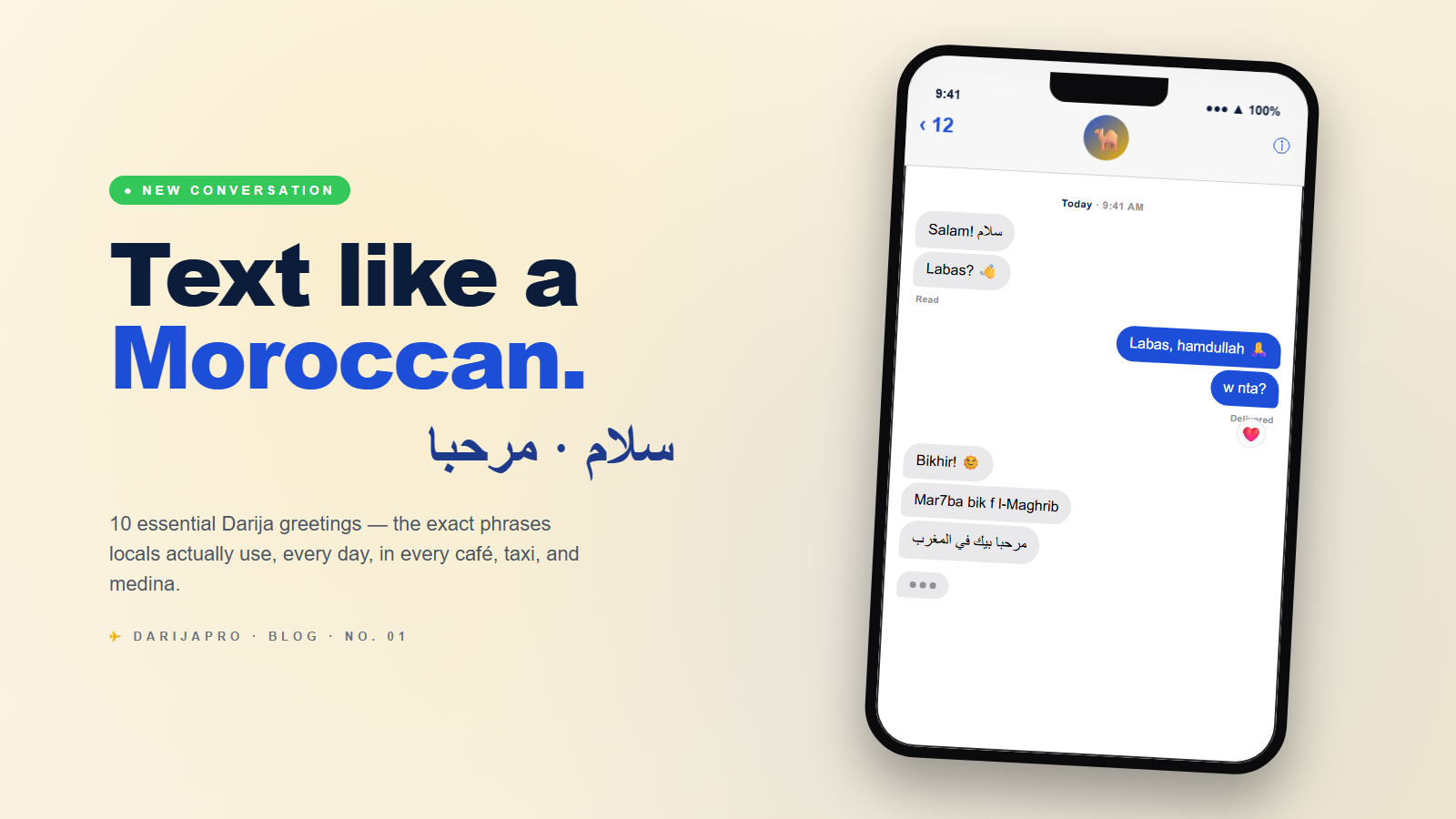
10 Essential Darija Greetings Every Traveler Must Know
From "Salam" at the airport to "B'slama" at the souk — open every door with 10 phrases.
 DarijaPro Team
In-flight reading
·May 19, 2026
·4 min read
·10 phrases
DarijaPro Team
In-flight reading
·May 19, 2026
·4 min read
·10 phrases
Your boarding pass is for one short flight. Ten phrases. Four minutes. A country's worth of welcome waiting at arrivals.
By the time the plane lands you'll know how to greet a shopkeeper at sunrise, soften a taxi fare without bargaining, ask about someone's family without sounding like a phrasebook, and say goodbye like you mean it.
You don't need fluency. You need ten phrases that work in the medina, the café, the train station, the kitchen, the rooftop. The ones grandmothers teach first, because they're the keys to every door behind them.
Tray tables up. Let's go.

Open any phrasebook and you'll find five hundred phrases waiting. By the time you've memorized how to ask 'where is the post office?' you've already missed the smile that would have opened the conversation.
Locals don't speak in phrases. They speak in a back-and-forth: a greeting, a return greeting, a soft how are you, an expected answer, a third pleasantry before any real conversation begins. Miss the dance and you're a stranger. Catch it once and you're a guest.
These ten phrases are the dance. help aren't on the list. Those you can mime. What you can't mime is the welcome that the right hello opens. These are the words that earn you better tea, fairer fares, slower speech from the person you just met.
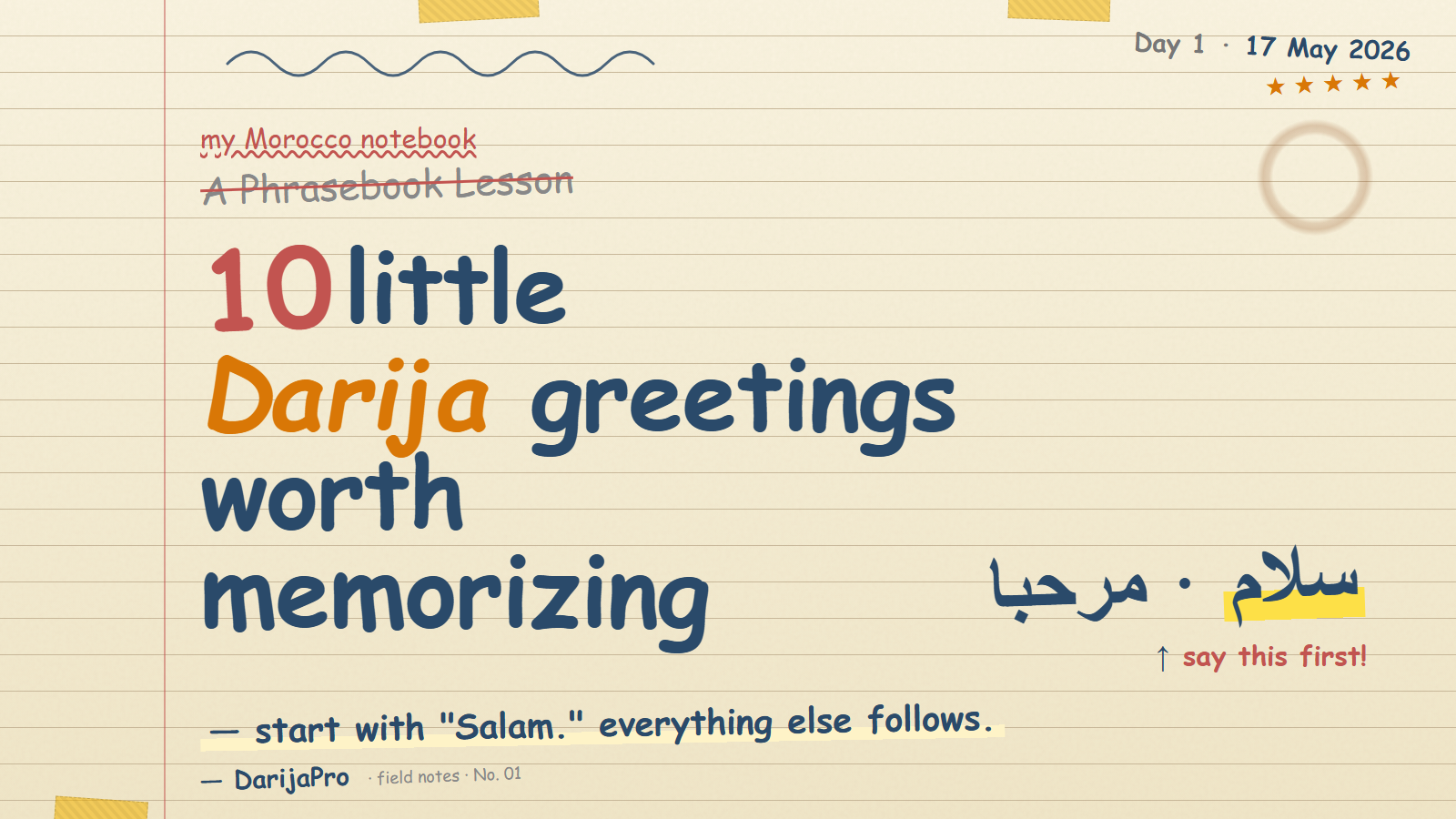

Captain's tip: say phrase #2 out loud. Yes, now. The first time it leaves your mouth in Morocco, you'll know why.
If you remember nothing else from this flight, remember the Salam–Labas exchange. Two phrases. One short conversation. Said so often you'll start hearing it as a single sound: Salaaaam, labas?
Here's how it goes. You walk in. You say Salam, labas? (Hello, no harm?). The other person answers Labas, hamdullah (No harm, thanks be to God). That's it. The conversation is open.
Notice what's not said. No how are you, fine, and you? No weather small talk. You're not asking for a status report. You're asking are things peaceful with you? and the answer means yes, and I appreciate you asking.
Once you've heard it a few times, you'll catch it everywhere. Two friends on a corner: Salam, labas? A shopkeeper greeting a regular: Salam, labas? A grandmother at her door, opening to a stranger: Salam, labas? Use it. It'll use you back.
Salam labas hamdullah — three words that mean "I respect this place," without literally translating to anything.

Why the 3 in 3afak? It's not a number — it's a sound. The Arabic letter ع (ayn) has no English equivalent, so when locals type Darija in Latin script they use a 3 because it looks like ع flipped. Pronounce it from the back of the throat. Fake it as a soft 'ah' and you'll be fine.
By the time the plane is descending, the cabin crew will tell you the weather and the gate. Here's the equivalent for greetings: five rules that decide which one to use.
Before noon, go morning mode. Sbah l-khir means good morning. It's reserved for the actual morning. Say it after 12 and locals will gently correct you back to Salam.
After dark, switch again. Masa2 l-khir (good evening) works from sunset onward. Café owners love it.
On Friday, add a blessing. Jouma3a Mubaraka (blessed Friday) earns smiles at any shop, sometimes a free glass of mint tea. Friday's secret password.
With elders, layer the politeness. Tack a quiet bikhir? (all well?) after your Salam when greeting someone older. It costs you one syllable and buys you a lot of respect.
When leaving, soften the goodbye. B'slama (with peace) is how locals say goodnight. Use it instead of bye. You'll sound like you've been here before.
That's the flight. Ten phrases, five rules about when to use which one. Use them with a smile and you've already done the hard part. The rest of the language is just stretches of road branching out from this one intersection.
You'll forget some. The ones you use will stick. Salam alone, said with eye contact, will carry you through your first week. Labas, hamdullah will carry you through the second. By the third week, you'll catch yourself adding bikheir without thinking about it, and a shopkeeper somewhere will smile at the way you said it.
When you're ready for what comes after these ten, the next lesson is one tap away. Until then, welcome to Morocco.
Ready for the next stop?
Log in to DarijaPro and keep going — happy learning.
LOG IN TO DARIJAPRO →- Cover image: DarijaPro
- Audio: Log in to DarijaPro to hear every phrase from native speakers
- Phrase verification: DarijaPro Editorial · native speakers
- Published by DarijaPro · 2026